Monday, July 21, 2014

The Girls of Summer: Gidget


Surf’s up, kids!  This month’s theme is the girls of summer – a gaggle of surf or party movies with a lady-centric bent.  And we’re starting off with the original surfer girl, Francine “Gidget” Lawrence.

Monday, July 7, 2014

HEROINES I HAVE KNOWN: Dixie Cousins


The 90’s: what a time to be alive.

I know 90’s-stolgia has painted the world in rose colors ever since the dawn of the Tumblr age, but as a decade it ushered in wide-ranging heroines of all sorts.  While you can say a lot about the representation the 10’s have happily ushered into the landscape, the 90’s were the only decade where you could worship at the altars of heroines as diverse as Khadijah James and Dixie Cousins.

Sunday, July 6, 2014

80's Month: Overboard and Feminist Backlash


The 80’s were an interesting time for women in the media.  Riding the burgeoning cusp of the second wave of popular feminism that would crash when the ERA failed and then reform  in the confused backlash  of the Anita Hill hearings of the 90s, media in general tended to be friendly to its newfound consumer base.  It was a giddy and confusing time, and it tended to wind up providing its audience with a mixed bag of independent, smart female characters…being told that the only way to be happy and have it all was to pipe down and raise up some kids. 

Television was lightyears ahead of the media in this regard; having worked out the kinks with That Girl and witnessed the adventures of Rhoda Morgenstern, Maud Finley, Hot Lips Houlihan, the Bunker girls and Mary Richards, the 80’s treated us to the Julia Sugarbakers, Murphy Browns and Golden Girls of the world. 

Movies were, however, still an uneven medium. In the 70s, for every Norma Rae there was a Sandy Olsen; and it’s just as true that for every Judy Benjamin in the 80’s, there was an Emmy from Mannequin.  In fact, Judy Benjamin herself appeared in one of the more popular of the feminist backlash films, a 1989 take on the Taming of the Shrew directed by Garry Marshall, Overboard.

Sunday, June 22, 2014

My Writing Process Blog Tour

I was invited by Christin Haws to participate in this blogaround!


1) What are you working on?: Next week, I'm going to wrap up my tour through various aspects of the 80's treatment of feminism in pop culture by taking a look at feminist backlash, as encapsulated by movies like "Overboard".  I am otherwise working on two screenplays a novel.

2) How does you work differ from others of its genre? It's sassy, smart, intense and impassioned.

3) Why do you write what you do? Because pop culture is a deeply rooted influence in my life and I have a burning need to explore it.

4) How does your writing process work?: One day of research, one day of writing, one day of editing.


I sadly don't have any authors I know offhand who I'd like to nominate, but if you'd like me to include your blog in this post and be next, reply to this post.

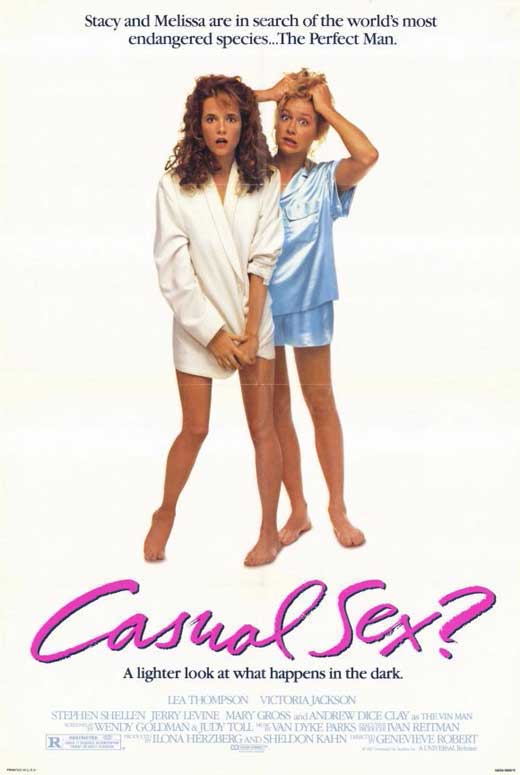
80’s Month: Casual Sex? And love in the time of AIDS


Among the many innovations exclusive to the era, The 80’s reinvented – through pure necessity – the sex comedy.   You can neatly split the era into two halves:  the freewheeling pre-HIV-era (Fast Times at Ridgemont High) and the neurotic post-AIDS years, of which Casual Sex? Is the epitome.

Popular culture dealt with the AIDS crises in numerous ways.  Some sought to confront it directly (various TV movies, and eventually TV sitcoms, did bits about the disease, culminating in popular explorations of the disease in movies and plays like “Rent”, “Angels in America” and “And The Band Played On”.).  Others ignored it by delving into the past (a general rise in nostalgia for the 60’s first occurred in the late 80’s, eventually culminating in a second Woodstock celebration in the 90’s) or advocated for free-love-with-a-rubber (80’s video culture).  And even more made jokes; many a 90’s child likely remembers watching Lt. Drebbin and his lady love Jane roll across their bed while wearing full body condoms in Naked Gun.   Casual Sex takes the comedy approach with a twist; it tries to be touching and whimsical in the same breath – and occasionally succeeds.

80’s Month: The Glass High Top: The deconstructed fairytales of Maid to Order and Pretty in Pink


Let’s face it, there’s only one major ensemble dramedy that dissects the high school experience and manages to be relevant even to this day – The Breakfast Club.  After the movie became a major hit, its two female leads were sent off on entirely dissimilar career paths:  while Ally Sheedy immediately took on adult roles in hits like St. Elmo’s Fire and Short Circuit, Molly Ringwald, much like her princessy character Claire, would end up stuck playing teenagers for five more years before testing the waters with The Pick Up Artist, Fresh Horses, and finally transitioning firmly into adult roles with Betsy’s Wedding in 1990.

The two would each take one more stab at trying to create classic films for teenagers; Ringwald would essay the role of poor teenager Andie Walsh in “Pretty in Pink” and Sheedy would play rich girl Jessica Montgomery in “Maid to Order” .  One would be a wild success, the other would be consigned to the one dollar cut-out bins across the country.  But why?  Let’s stack the classic against the unknown and see how – or if – they stack up.

Tuesday, May 27, 2014

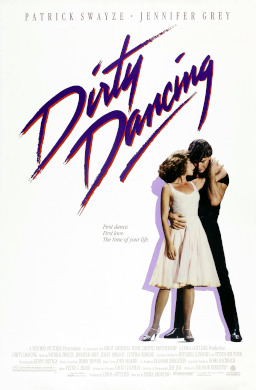
Feminism, and feminist backlash, in 80's films: Part 1: Dirty Dancing


Summer means a lot of different things to me.   Hot days, sandals, beaches, watermelon – and Dirty Dancing. 

Released in 1987, Dirty Dancing caused a sensation, becoming a huge hit, spawning two soundtrack albums, and unsuccessful series on CBS,  and a worldwide concert tour  It launched the careers of Jennifer Grey and Patrick Swayze from erstwhile supporting players into the mainstream and lead roles.  Nowadays, it’s settled into an object of campy nostalgia for the many who wore out VHS tapes of it in their youth, and it’s become the sort of a summertime staple of networks like WE and Lifetime.  Fondness for the movie continues – you can buy teeshirts for it, and watch its recently spawned (and  too-late) sequel  or the Broadway musical it inspired.

There’s something very amusing about a movie like Dirty Dancing ending up a fluffy nostalgia piece that’s considered an inconsequential romantic movie.  Here’s the movie’s biggest secret:  it’s a socially radical film that embraces feminism and sisterhood, makes a strong case for abortion rights and artistic freedom, and shows a woman’s first happy sexual affair to be consequence-free in the way of romantic heartbreak and the moral weight of STDs, cheating, and pregnancy.